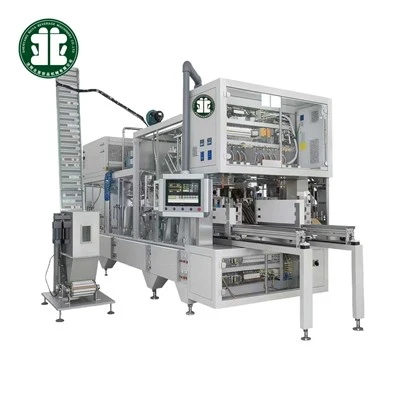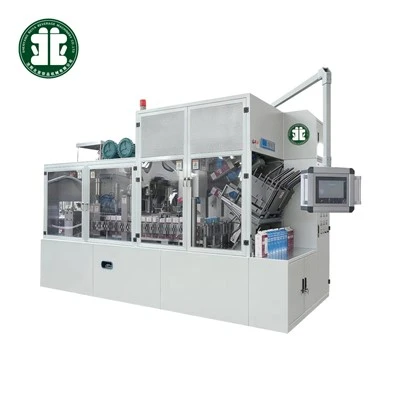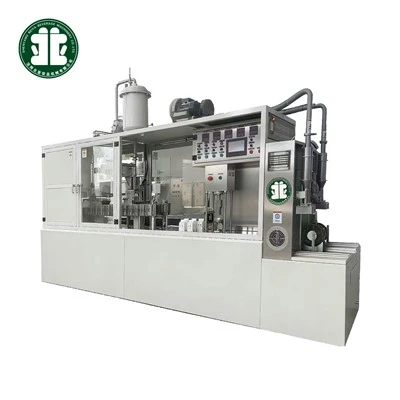

The general process of a liquid filling machine is as follows: Boxes containing empty bottles are stacked on pallets and conveyed by a conveyor belt to a pallet unloading machine. The pallets are unloaded one by one, and the boxes are conveyed to a case unloading machine where empty bottles are removed from the boxes. The empty boxes are then conveyed to a case washing machine for cleaning, and then to a case packing machine for filling with beverage bottles. Empty bottles from the case unloading machine are then conveyed by another conveyor belt to a bottle washing machine for disinfection and cleaning. After inspection by a bottle inspection machine, bottles that meet cleanliness standards enter the filling and capping machines. Beverages are filled into the bottles by the filling machine. The bottles are then capped by the capping machine and conveyed to a labeling machine for labeling. After labeling, they are sent to a case packing machine to be packed into boxes, and then to a pallet stacking machine to be stacked on pallets and sent to the warehouse.
With the development of automation and intelligent technologies, the workflow of modern filling machines is now precisely controlled by intelligent systems such as PLCs. Its core processes include container conveying and positioning, empty container detection, quantitative filling, quality re-inspection, and finished product output.
The rotary fully automatic filling machine operates as follows: Bottles are manually fed to the conveyor belt, then automatically fed to the rotary table. The rotary table rotates automatically, performing automatic quantitative coarse filling when empty cans are available. If no cans are available or if secondary fine filling is required, coarse filling is not performed. The rotary table then rotates to detect weight and determine the fine filling volume, followed by automatic quantitative fine filling. Finally, if the product is合格 (qualified/acceptable), it is output by the conveyor belt; otherwise, it is cycled back to the secondary fine filling stage.
The stand-up pouch filling machine is a production line integrating filling, capping, and cleaning. It is suitable for automatic quantitative filling of spouted soft packaging bags. Its workflow is controlled by a PLC and a rotary encoder. The PLC reads the rotation angle of the spatial cam detected by the rotary encoder. When the rotation angle reaches a preset position, it controls each actuator to sequentially complete the filling, capping, and cleaning actions.
Furthermore, the core principles of the filling process vary depending on the materials and industry requirements. For example, in the food and beverage industry, aseptic filling uses a hydrogen peroxide vapor plus ultraviolet pulse sterilization system, while high-viscosity sauces use piston filling combined with screw pressurization. Beverage isobaric filling requires pre-filling CO₂ to build pressure balance, and the pharmaceutical industry uses a high-precision cam plunger pump to achieve micro-level filling.