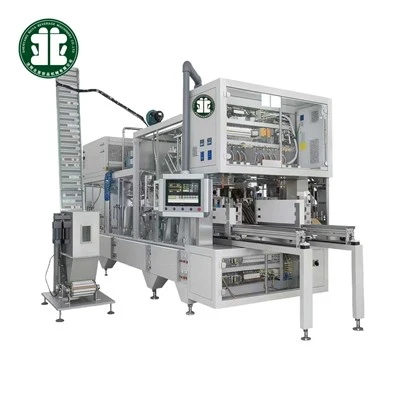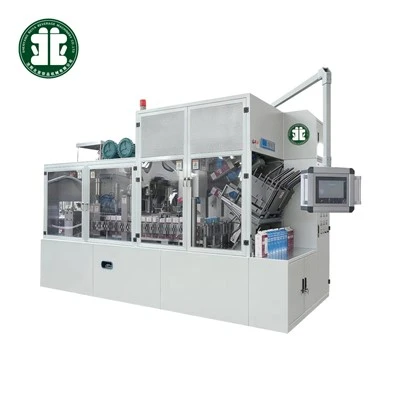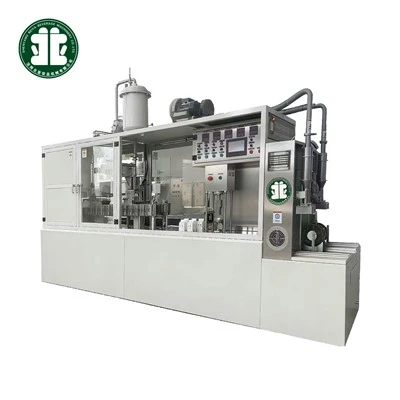

Most carbonated beverage filling machines are either positioning or quantitative, meaning the material is always a certain distance from the bottle opening. Juice filling machines, however, require full-bottle filling, meaning the bottle is filled completely. This minimizes residual air, ensuring the beverage is less prone to oxidation and maintaining its quality over a longer period. Hot filling requires the juice beverage to be sterilized at UHT (ultra-high temperature) and maintained at a constant temperature between 85-95°C, with filling completed in a very short time; this is considered high-temperature filling. Because hot filling machines for juice beverages need both high-temperature and full-bottle filling capabilities, they require an automatic circulation system for low-temperature material recirculation and CIP (Clean-In-Place) cleaning. Hot filling machines should have the following functions:
Reflux control function. The hot-fill machine is designed with the material filling port located at the bottom of the valve core, and the venting channel is an external return channel for the valve core. Venting and liquid inlet follow separate paths, ensuring that air expulsion from the bottle does not obstruct the material flow rate during filling. This prevents the venting from affecting the uniformity of filling across valves, guaranteeing no material backflow during the juice filling process and easily controlling backflow after the bottle is full.
Automatic circulation function. According to the hot-fill beverage production process requirements, if the beverage temperature in the filling tank drops before or after the hot-fill machine starts up, or during a stoppage, it must be reheated until the set temperature is reached before refilling. Furthermore, after continuous production for a period of time, or during shift changes, the filling material channel must be circulated and cleaned. Therefore, the hot-fill machine should have an automatic circulation system.
Bottle neck filling and conveying. When filling heat-resistant PET bottles at high temperatures, the biaxially oriented PET will shrink upon heating, with a shrinkage rate typically ranging from 1% to 3%. The bottle neck area has the greatest strength, necessitating a bottle-neck positioning method during filling to prevent deformation caused by external forces. Simultaneously, for well-filled beverages, using a bottle-neck conveyor prevents spillage due to vibration and compression.
Full-mouth filling. Currently, there are two common hot-filling methods for juice filling machines in China: one where the inlet and return channels of the filling valve open and close separately; and the other where they open and close simultaneously. Based on a thorough absorption and assimilation of foreign technologies, a superior hot-filling machine filling valve has been developed and designed. The filling valve has two material filling ports located at the bottom of the valve core. This minimizes the space occupied by the valve core head at the bottle opening. During filling, the filling valve is inserted into the bottle opening. Towards the end of filling, the inlet and return channels of the filling valve close sequentially and in stages. As the valve leaves the bottle opening, the volume it occupied is replenished by the beverage in the return channel, ensuring the entire bottle is filled-a full-mouth filling.
Fruit juice beverages typically employ two methods: high-temperature hot filling and cold aseptic filling. Due to various limitations, domestic companies generally use the former. The production process for fruit juice beverages has strict requirements. Considering the technology of PET bottle filling machines, the operability of the production line, and the quality of the beverage, hot filling is the more economical and reliable option.