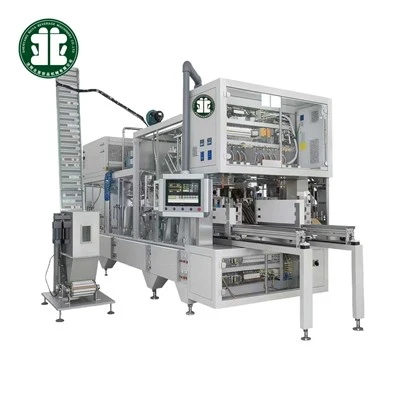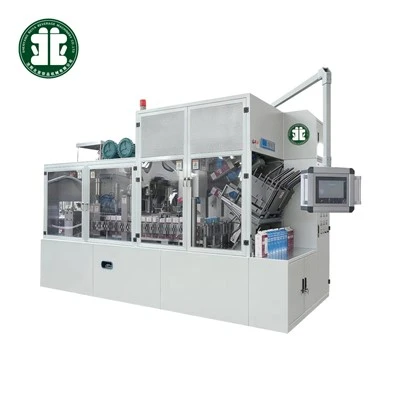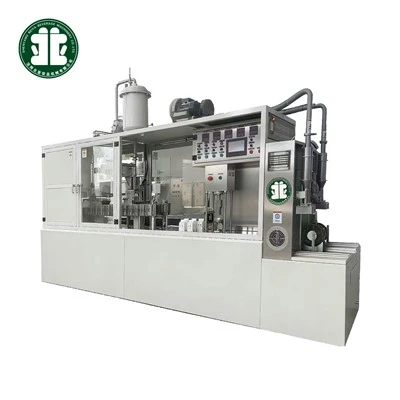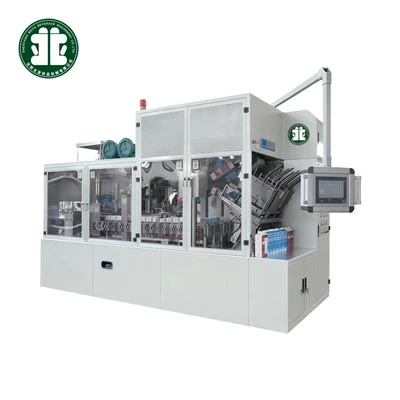

A gable-top carton filling production line typically consists of a carton-making machine and a filling machine, both constructed from 304 food-grade stainless steel. The workflow includes manual placement of the carton/cardboard, bottom forming and sealing, filling, top forming and sealing, and date printing. The entire process is automatically controlled by a PLC, requiring 1 to 3 operators.
Key performance and technical parameters include a filling capacity range of 250-1000ml (single-machine filling possible), and production capacity of 800-1200 cartons/hour for the BW-1000 model and 1800-2500 cartons/hour for the BW-2500 model. Filling temperatures include cold filling (2-5°C) and hot filling (up to 88-92°C). The supporting utilities require compressed air at a pressure of 1.0-1.4 MPa and a flow rate of 0.8-2.0 m³/min. This air must be oil-free, water-free, and dust-free. Cooling water is also required, with a flow rate ≥20-40 L/min and a temperature of room temperature or ≤30°C. Packaging materials are cardboard boxes/aluminum foil boxes .
Gable-top cartons are commonly used for filling pasteurized fresh milk. The pasteurization process typically maintains a temperature of 72°C~85°C for approximately 15 seconds. After filling, the product must be refrigerated and stored under a cold chain condition of 2°C~6°C, resulting in a relatively short shelf life, generally around 7 days.
The "SchoolPOP" strawless gable-top carton design developed in Japan modifies the lower structure of the gable mold to facilitate finger insertion for opening and optimizes the spout angle for smooth pouring and direct consumption. This design eliminates the need to replace the entire filling line; only some parts need adjustment for production. It is primarily used in scenarios such as school lunch milk, aiming to reduce the use of disposable plastic straws.